





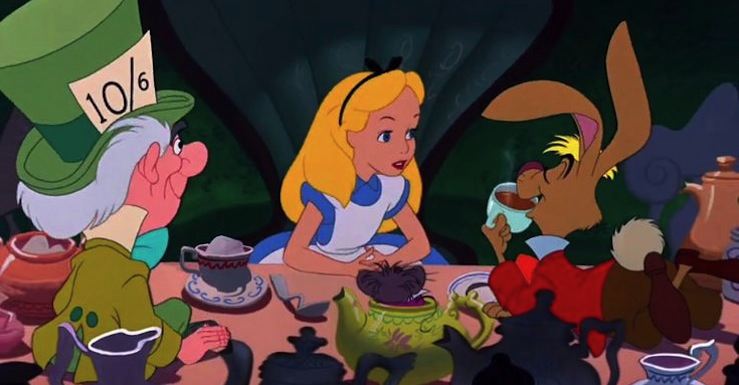
Years later, Walt Disney tried to avoid responsibility for Alice in Wonderland (1951) by claiming he’d never wanted to make it. This was at best disingenuous: Disney had actually started development of the film back in 1933, and before that, he had made two short films inspired by the Lewis Carroll classic. (My previous review of the book here.) Clearly, the idea of a child falling into Wonderland had a strong hold on him. So after his firm’s fortunes slowly began to climb back from the nadir of the postwar years, he set his animators on Alice in Wonderland, developing the film right along with Cinderella, creating a race to see which could be completed first.
Alice in Wonderland lost, on more than one level.
A significant problem for the film’s development turned out to be the original illustrations by Sir John Tenniel. By the 1940s, those illustrations had reached iconic status, and animating Alice without referencing the illustrations seemed impossible. But basing an animated Alice on those illustrations seemed even more impossible. Tenniel, after all, had not been concerned with the issues involved in making drawings move across a screen, but rather how to make illustrations pop out from a newspaper page. As a result, his illustrations followed the classic British newspaper cartoon tradition, which meant, simply, that his images have a lot of lines. That’s great for illustrations in books, which only needed to reproduce the lines once per printing, but a disaster for an animated film, which had to reproduce those lines, with subtle variations, multiple times in order to make the drawings seem to move on the screen. Even in the computer animated age, this is difficult. In Frozen, for instance, most of the characters wear relatively simple costumes, and the side characters include a white snowman (very few lines) and a brown reindeer (ditto). In the hand-drawn, hand-inked era of Alice in Wonderland, it was prohibitively expensive. Disney faced a conundrum: the studio needed simple clean animated work that could be done swiftly and still resemble the Tenniel illustrations—a puzzle no one could solve.
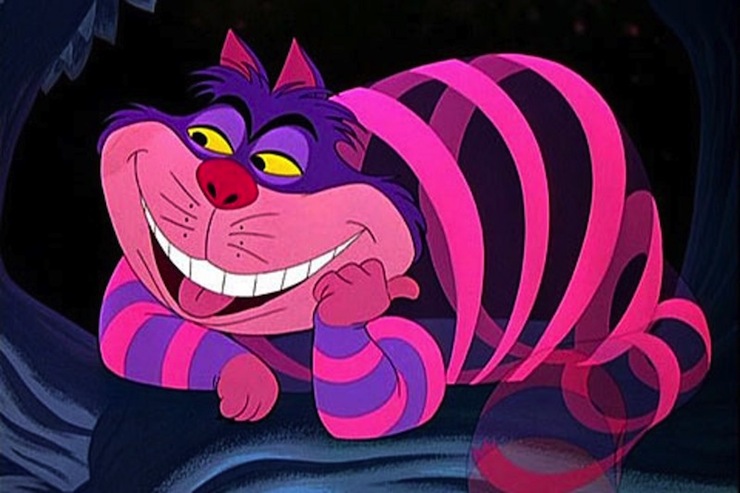
It did not help, of course, that Disney had set all nine of his major animators on Cinderella, ordering them to direct most of their attentions to that film. Ward Kimball took the skills he’d used to create Lucifer the Cat to help bring the Cheshire Cat to life in this film, which perhaps explains why the Cheshire Cat in Alice looks a bit more like Lucifer than the Tenniel illustrations in most shots. Les Clark animated both Cinderella and Alice; Marc Davis animated both the stepsisters and Alice; Ollie Johnston animated the stepsisters in a couple of scenes—and Alice; and so on. What you should be getting from this is that a number of animators took turns with the film’s main character of Alice. This was hardly uncommon in Disney animation, but prevented anyone from developing a distinct, individual take on Alice—with the result that she became one of the blandest of Disney heroines.
Story development raised another issue. As with Bambi, the Disney animators were developing a story that did not, strictly speaking, have a real plot. In the book, Alice simply falls down the rabbit hole and wanders from linguistic joke to mathematics joke to linguistic joke again. Her goal, such as it isn’t, is to reach a lovely garden that she catches glimpses of here and there, but this goal is frequently forgotten for pages and pages, even by Alice herself. By the time she does reach the garden, she’s mostly forgotten that she even wanted to get there, and once she is inside, the book continues for five more chapters, never really acknowledging that Alice achieved her goal. The sequel, Through the Looking Glass, has a slightly tighter plot, in that Alice is moving across a chessboard in order to become a queen, but only slightly tighter.
Lacking a unifying plot, the animators went for a moral instead: “Be careful what you wish for.” Not a bad moral, as morals go, but establishing this concept meant that instead of starting the film with a time-obsessed White Rabbit, the film instead started with Alice singing a song, immediately slowing the film. This also meant that Alice had to actually suffer from time to time, forcing tweaks to the storyline—most notably in the Tulgey Wood sequence where Alice, finally attempting to get home, finds herself lost and terrified by bizarre creatures—who never speak. If that sounds odd for something written by the wordplay, conversation obsessed Lewis Carroll, well, it’s not from Carroll, but Disney, and probably not coincidentally, it’s one of the weaker parts of the film.
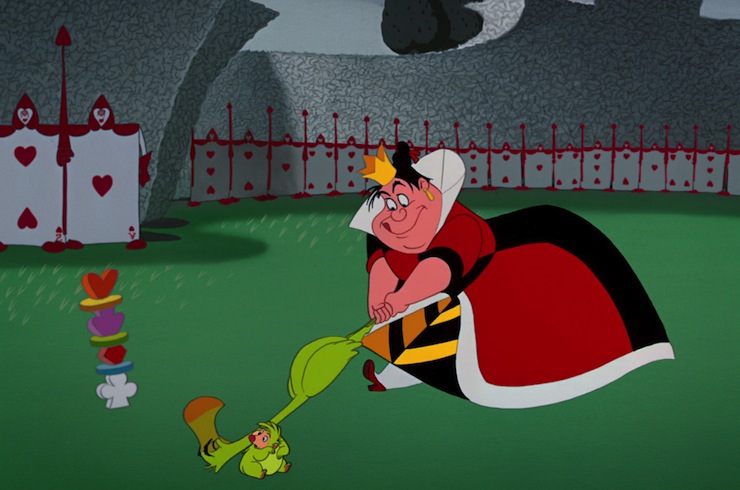
The animators also added other bits and characters to the original story. Alice’s first arrival in Wonderland, for instance, originally marked with silence and items ominously labelled “Drink Me” and “Eat Me,” was augmented by the addition of a talking doorknob who wants to tell door jokes. Several characters were brought over from Through the Looking Glass—most, granted, as replacements for other characters. Tweedledum and Tweedledee largely took over the roles of the Mock Turtle and the Griffin (and to a lesser extent the Duchess and the Red Queen), for instance, this in part because Disney didn’t find the original characters all that amusing when transferred to the screen. Other characters were combined, not always to anyone’s benefit—the decision to give the Queen of Hearts some of the mannerisms and speeches of the White Queen, for instance, was just not a wise move.
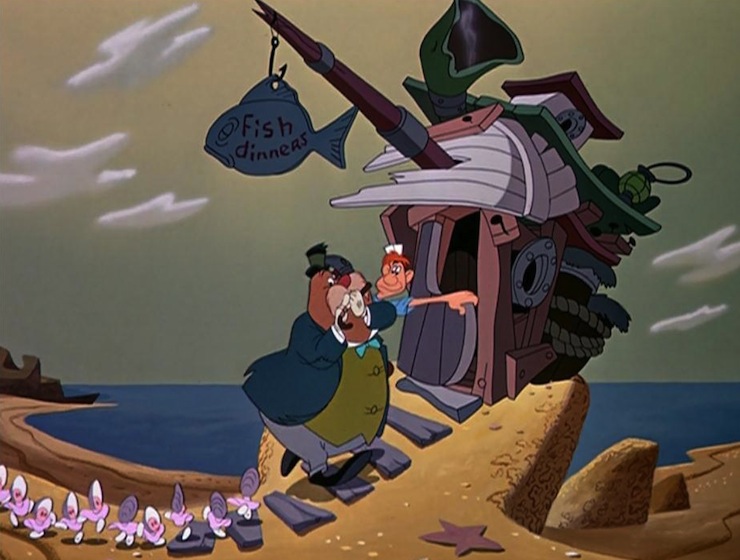
Disney also chose to fill the film with various musical numbers, partly because the original Carroll books did contain several pauses for nonsense poetry, and partly because by now this was a Disney film trademark. One or two of the songs do work well, particularly those based on Carroll’s original poems. Others, especially “The Walrus and the Carpenter” number, not only do unwarranted things to Carroll’s lyrics, but genuinely feel as if they are separate cartoon shorts, just tossed into the Alice film. That is, in a way, a nice throwback to the books, which move from disconnected incident to disconnected incident, in the matter of dreams, but works a little less well in an animated film.
And, as they had been in Bambi, the original Disney songs were complete flops, particularly Alice’s solo “In a World of My Own.”
In part this was because of Kathryn Beaumont, only thirteen when she voiced Alice, audibly struggled with the singing parts—something she did rather too much in this film. But mostly, this is because they are just not very good songs.
I can’t blame the other problems with Alice on Beaumont’s voicing either. (Nor did Disney, who happily hired Beaumont again to voice Wendy in Peter Pan.) In the books, Alice is an intelligent, if easily frustrated and irritated child. Then again, she does seem to have quite a lot to get frustrated and irritated about—I cannot see a grownup responding any better to the tea party with the Mad Hatter and March Hare. But, even frustrated and irritated, Alice manages to reason her way through at least some of Wonderland’s logistical impossibilities, and occasionally even hold her own against the linguistic wordplay of some of the creatures she encounters. More so, granted, in the sequel Through the Looking Glass, but I can’t help but think that if the film could borrow characters from that sequel, it could borrow characteristics, too.
But in the film, Alice is continually bested by the characters she encounters. Even one of her most triumphant moments—rapidly growing to a grand size that allows her to dominate the Queen of Hearts—is undercut when she suddenly shrinks again and finds herself terrorized again. She spends much of the film begging the White Rabbit to talk to her (he ignores her.) And her dream, rather than ending on a victorious note as it does in the book, ends with her fleeing in tears, needing to get told by a doorknob that she’s only dreaming, and screaming at herself to wake up. She does—only to have her dreams dismissed by her sister. In the book, the sister listens, and for a moment, dreams of going to Wonderland herself. It’s a validation, instead of a dismissal. Arguably worse is Alice yawning during one of the musical numbers—a chorus of singing flowers—not to mention her occasional expressions of boredom and irritation during her trial.
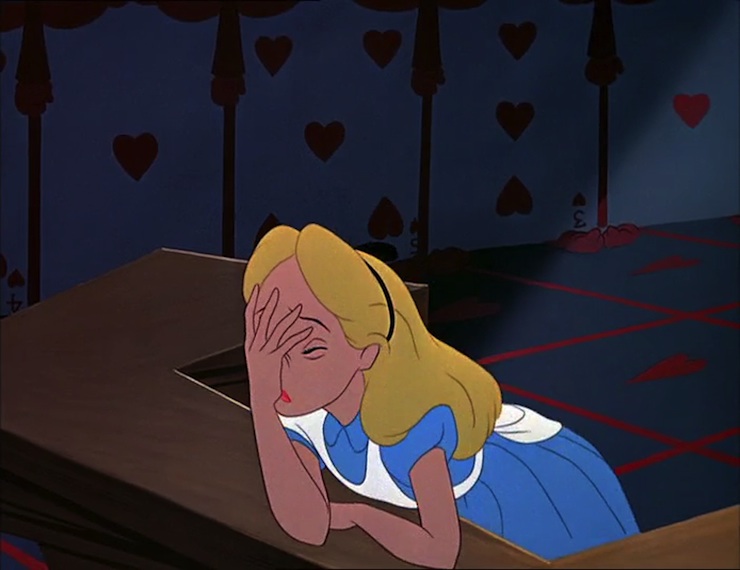
If the main character is bored by events on the screen….well.
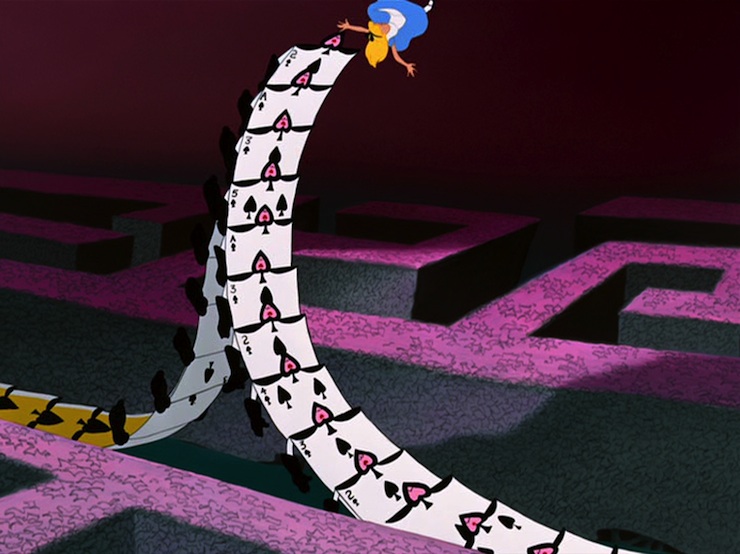
And yet, sprinkled throughout all this are some delightfully trippy—for want of a better word—moments. The initial fall down the rabbit hole, for instance, with Dinah the cat waving a rather stunned goodbye; the arrival of the Queen of Hearts and her army of playing cards; and the final chase scene, featuring nearly every character from the film. The Tea Party with the March Hare is arguably one of the best, if not the best, filmed adaptations of that scene. And if I’m not exactly satisfied with the character of the Queen of Hearts, every scene involving her remains delightfully weird, and the expressions on the faces of the poor flamingos forced to be croquet mallets are marvelous. Portions of the film are marvelously surreal, which possibly explains why so many people later chose to watch it while totally stoned.
Plus, for all of the difficulties involved with animating the film, Alice in Wonderland features some of the best animation the studio had offered since Bambi. The backgrounds are still simple, but unlike in Cinderella and many the anthology features, most of the scenes contain several animated characters, not just one. Nothing approaches the complexity of Pinocchio or Fantasia, but a few scenes—notably the ones with the Queen of Hearts and her walking, fighting playing cards—give a sense that the studio was starting to climb to animated heights again.
My guess is these were the right animators at the wrong time. What Disney needed in the early 1950s were films that focused on stability, on reassurance, on good winning out over evil—all elements found in Cinderella. Alice in Wonderland isn’t that film. Had it been finished in the 1930s, or even the 1940s, and allowed to exploit the weirdness inherent in the original text, and allowed to reach its imaginative heights, this easily could have been another Pinocchio. Instead, it’s a film with odd moments, odd pacing, a moral that hampers the film, and a sense that it could have been so much more.
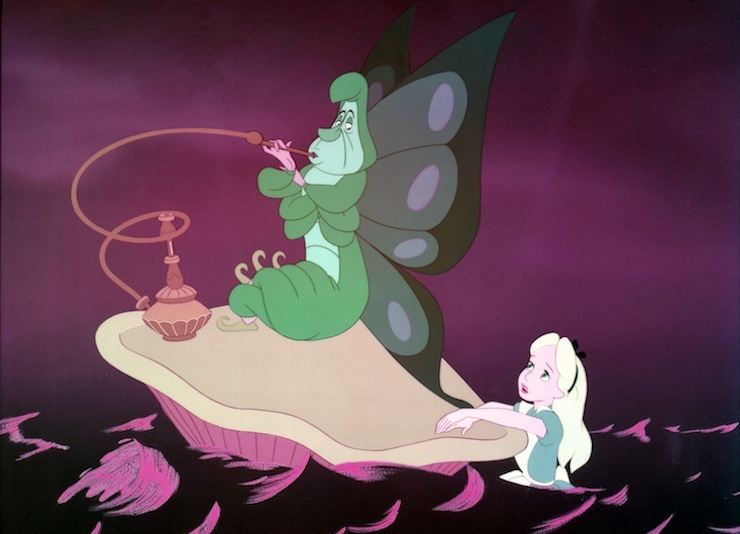
One other small change: in this 1951 film, only one character—the Caterpillar—is seen smoking. (Perhaps tobacco, but given his dialogue, it might be something rather less legal in the period and still not all that legal in some areas where Disney animators currently work.) And in a major change, that cigarette smoke has an immediate effect on Alice, who is seen choking on it. At least three other characters in the film could presumably smoke cigarettes, but don’t. It’s not quite an anti-smoking message, but it is a distinct change from the casual smoking that pervaded Pinocchio and Dumbo.
To sum up, it’s a bizarre little film, probably worth at least one look. But “bizarre” and “little” were not what Disney films were going for, then and now, and for years the company regarded the film as a failure. Corporate legend claims that Walt Disney didn’t even want the film mentioned in his presence, although he was willing enough to discuss its failures in interviews.
The turnaround for Alice in Wonderland came in the late 1960s, when several college students discovered that the film played very well if the audience ate illegally enhanced brownies just before and during the film. Disney understandably resisted this connection, but after Walt Disney’s death in 1966, the drug-enhanced viewings raised the film’s status and popularity just enough that the company began to occasionally rerelease the film, eventually allowing it to earn back the money it lost in its original release, and even earn a profit. In another positive impact, the film also inspired the Mad Tea Ride, one of the few rides that appears in all five Disney parks, thanks to its (to me, inexplicable) popularity.
But to keep the company going, and to let Disney build those parks, the company needed something far more popular. Another British adaptation, perhaps, but something with fairies, and a bit more plot. Something like, say, Peter Pan.
Mari Ness lives in central Florida.



As I said when I read your review on the novel – this is isn’t one of my favorite Disney movies, but I found the book way worse and much more dull and nonsensical. Not that the movie really makes much sense either; it’s basically watching poor Alice go from one horrible/scary thing to another in a world that makes no sense and is practically Kafkaesque, and then all turns out to be a dream. Parts of it drag; I always hated the part with the lizard in the house because it’s the type of hijinks humor I can’t stand. But I definitely enjoyed many of the surreal scenes and songs and what not…actually the Tulgey Wood scene was one of my favorites as a kid (and also very scary/sad to me). I also really liked the flower song (Golden Afternoon).
Maybe I’m in the minority, but I don’t find Peter Pan that much better. In fact, I think I enjoy Alice more than Pan. I wonder how much of that is nostalgia; Alice is one of the movies I had (on an old VHS that also contained a Punky Brewster episode, so those two are forever linked in my head) as a young child, so it’s very much a classic Disney movie to me. Peter Pan I didn’t really see until much later (late teens, perhaps?). It definitely didn’t imprint on me though.
I seem to remember that Walt famously once said that the problem with ALICE is that it “lacked heart.” I think what he meant by this was, Alice (the character) is pretty much passive throughout the story. Things happen to her, but she doesn’t really effect changes on the other characters nor does she change much herself (other than the halfhearted “lesson” of being careful what you wish for). As such, it’s hard to feel genuine sympathy or empathy for what she’s going through, or to care much about any of the other characters, for that matter.
In many respects, the denizens of Wonderland and their antics are more akin to the random slapstick and surrealism of 1920s and early 1930s animation (think of the dark weirdness of the Fleischer Betty Boop cartoons or the chaotic craziness of early Terrytoons or Van Beuren). For me, at least, it’s those parts that I can still watch and enjoy: bits like the Caterpillar’s wordplay, the Mad Tea Party (two old vaudevillians, Ed Wynn and Jerry Colonna, having a great time), and the Tulgey Wood (whose inhabitants seem to have wandered over from Bob Clampett’s 1938 “Porky in Wackyland.”)
Definitely one of those Disney films where you “save the pieces” and try not to be bothered that they don’t add up to a satisfying whole.
@Lisamarie, when I was in elementary school, we performed the Trial of Alice in Wonderland, which was really just an excuse to have all the characters in one spot so we could perform the songs from the movie. I was Rose, because OF COURSE I WAS
Never had this one as a kid, but the parts I had seen of it were never really all that appealing to me, and in some ways, repulsive. Finally seeing the whole thing as an adult, and being open to it, I was mainly just rather bored with it.
Keep that tea cup ride far, far away from me though. I really can’t stand being dizzy.
oh gosh, the Teacup ride was my salvation when my kids were small. It’s the only ride in Fantasyland that moves faster than a crawl and also is pretty high capacity, so you never have to wait long. I was so glad the kids loved it- we could do the teacups three times in the time it took to wait once for Peter Pan (or god forbid, Dumbo, which is the slowest moving line in the entire freaking park I suspect).
I do dislike the Alice in Wonderland ride at DL itself, though. I rode it again recently, after it was refurbished, and it’s still just as dull punctuated by really loud noises and weirdness and then it just stops (kinda like the movie, I guess, which has never been a favorite either). bleh. I wish they’d rip it out and put something better in there.
@1 Was there already a post on the Alice in Wonderland book? Last week’s article was on the Cinderella movie. I can’t find one in between, although these posts don’t seem to actually be connected in a Tor.com “series” so it’s hard to tell. Usually the book review comes before the movie review, so I was a little surprised to see two movie reviews in a row…what did I miss?
Mari posted a link to her original review, which pre-dates the read-watch.
However, now that I look at it, perhaps that should get the read-watch tag (or they can make a series for it and add it) so it can be more easily found.
Huh, you’re right, it’s linked. I completely missed that somehow (to be fair, the link itself is only the word “here”, but still).
I remember the Alice movie being fun, but rather unmemorable for being so trippy. The book was quite a bit better with all the wordplay and amusing conversations, if you like that sort of thing (which I do).
Seriously? No mention at all of Mary Blair?
@Beastofman – It’s already a long post!
But, re: Mary Blair –
It’s fascinating to compare the pre-World War II concept art by David Hall – which followed Tenniel, creating drawings that would be hideously expensive to animate – and the post-war concept art by Mary Blair, which, if not quite ignoring Tenniel, did go with a bold, bright look with fewer lines that was considerably cheaper to animate.
I think, however, that Blair came much closer to the spirit of the original with her work for Peter Pan, even though I’m not particularly fond of that film.
@Everyone – Yeah, I’m skipping posts where I’ve already written about the book for Tor.com. I think this is only going to come up one more time, with The Black Cauldron. I’ll try to do a better job of highlighting the link to that post when we come to it.
This is one of my least favorite Disney cartoons, I think because of the wandering narrative and strangeness of it all. I was a very focused little boy, and liked things that were linear, internally consistent and clearly plotted.
I think this is another one where I had the story/songs record as a kid but didn’t see the actual movie until much, much later. In fact, I’m not sure I saw it until adulthood when it was on the Disney channel (and I found it kind of dull). This was an odd one in that they don’t use the actual soundtrack of the film on the record. I don’t know who did the singing/speaking, but the record versions of the songs are much better, and it includes the jazzy “Jabberwocky” song that I don’t think ended up in the movie in full, and not in the version on the record. I’ve always loved the ballad “Very Good Advice,” but I don’t like the way it comes out in the movie.
I’d read the book, so I mentally fleshed out the whole thing with the songs, and the movie in my head was much better.
Not much to add, but I once went to a concert where the artists performed Jabberwocky as an epic poem, in English and French.
Re: Cinderella from last week. There’s a live action musical version called The Slipper and The Rose. It’s been ages since I’ve seen it, but it was pretty good.
I like the tea party and the playing cards. Don’t like the movie as a whole. I think that the moral “Be careful what you wish for” was about as appropriate to the story as “There’s no place like home” was to The Wizard of Oz. Wonderland has nothing to do with anything Alice might have wished for; it comes out of left field. Or rather, it stays in left field.
Part of the charm of the books is that the humor is sophisticated, and the child reader knows s/he is not being talked down to. S/he is in on the joke, and the joke is on annoying aspects of the grown-up-run world. The humor makes the child feel smart (uglification and derision). None of this translates to the movie.
My eldest daughter, who saw it for the first time in preschool, enjoyed it because while Alice was singing “A World of My Own,” I leaned over and whispered, “Pssst–she’s falling asleep.” As a full-color unspooling of an imaginative little girl’s dream it works very well. (She passed the secret on to her little sister, who told her little brother. They all still love it, years later.)
Wow this is the first time I have ever heard of alice in wonderland as a failure. I love this movie and the books. But wow…what ever.
Are you going to spend any time at all on the live-action television show Disney ran in the early 90s? It was called Adventures in Wonderland, and stands out in my memory for having several characters of color – the Queen of Hearts, Tweedle Dum and Tweedle Dee, and the Walrus were all black. It also had a genuinely talented cast; the singing and dancing is actually pretty impressive for a children’s show (consider that the White Rabbit often got called on to do softshoe and tap numbers in a…………..pretty hefty costume) even if the actual material was often lackluster.
It is a children’s show, with all the implications that makes toward the show’s quality, and isn’t something I’d necessarily recommend watching more than one episode in a row of, but I think it’s worth at least a mention, if you weren’t aware of it!
I TOTALLY remember that! And I also remember being quite confused when I first watched it because it wasn’t anything like the movie, which was my only exposure to Alice in Wonderland at the time. If I recall, it took a lot from Through the Looking Glass (which I hadn’t really known about until then).
I think there was a scene where she had a baby carriage with a pig in it and that was a bit scary to me!
@dwcole – Alice in Wonderland was a box office and critical failure on its original release, to the point of bringing the studio to near bankruptcy again; Walt Disney himself criticized the film. To this day it’s one of the worst performing (in financial terms) of the animated films supervised by Disney.
@SunDriedRainbow – I never saw the actual show, but I did see the soundstages! It was filmed at what was then MGM Studios (now Hollywood Studios) at Walt Disney World back when Disney was sticking to their original plan to actually have an animation and film studio there. During the then-backstage tour (currently on hold to accommodate Star Wars weekend) tourists could look at the Alice in Wonderland soundstages. I think some of the costumes might still be around.
I have no idea if I can track down a copy of this, but if I can and Tor.com seems interested, I can take a look once this rewatch is done.
“some delightfully trippy—for want of a better word—moments.”
Heh. The only time I saw this film I loved it. I dropped 4 hits of acid half an hour before we put the VHS tape in the player. It was July 4th of 1989, and we went into DC afterwards to watch the fireworks. Ended up in Georgetown. One of the most bizarre trips ever.
A nit:
That’s 1966, an “the” is extraneous.
@21 – Thanks, fixed!
Disney’s Hollywood Studio backstage tour is, if rumor can be believed, gone forever, to make room for new attractions that will supposedly be announced in August, and will probably involve either Star Wars or Pixar themes.
AlanBrown – This appears to be true. I was at Hollywood Studios this weekend for Star Wars weekend, and the Backstage Tour area has signs indicating that a new set/ride/something is coming.
Chiming in extremely late, but wanted to note that Salvador Dali was hanging around the Disney studios in the mid-1940’s and could have inspired some of the trippier moments. (He was collaborating with Disney on the short Destino, which wasn’t released until 2004.) Lobster Alice by Kira Oblensky is a fun, surreal play which imagines the meetings between Dali and a (fictional) Alice animator.
Box office failure or not, I really enjoyed this film and felt it crystallised the central predicament of the character almost better than the book on which it was based: that of an utterly sane character trying to negotiate her way through an insane world (I’m guessing most of us have have had a similar experience while dreaming) with the tulgy wood being a high point. In this regard Alice’s ‘blandness’ as a character is largely a matter of context.
Alice is my all-time favorite Disney heroine. She’s so charming and adorable, and Kathryn Beaumont portrayed her perfectly. Also, her bloomers (long frilly underwear) are very cute, and I just love the way her dress poofs up like a parachute. I love the part where she flips over as she waves goodbye to Dinah. And “In a World of My Own” is a very beautiful song I could listen to all day.
Has always been my favorite Disney animated movie for all the reasons you list! I always loved that it was just about a girl and her journey with no prince in sight to save her. She was always the smartest person in the room—or at the tea table, as it were. And her yawning and boredom felt real and relatable as a child — how many adult dinner conversations put me to bed in the restaurant booth when I was little! The “Very Good Advice” song at the end is heartbreaking and relatable now, even as an adult. We’re all F-ups, we keep repeating patterns and none of us know why even with all the self-help books out there. For me, this was on par with “The Little Prince” in terms of existential angst masquerading as children’s entertainment. It was the Thinking Person’s Disney movie. I never knew it was considered a failure until now.
Anent nothing in particular,
anyone who loves the Alice books who hasn’t already read the Martin Gardner “Annotated” edition, I have such envy for you, as you’ll be able to read it for the first time.
Hie thee to a bookstore, quickly.
You can thank me later.
Cheers
I could not agree more. It is a butchering of Carroll’s masterpieces, with no bite whatsoever. It irritates me how this is the most widely known version, I really do hate Disney and all of his bland cloying adaptations.